Sent Principles Of Electric Circuits- Conventional Current Version 10th Edition Pdf -
Sending the product data sheet to your e-mail address.
Inquiry sent Principles Of Electric Circuits- Conventional Current Version 10th Edition Pdf -
Request information about the product to your e-mail address.
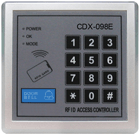
Access controls / Code keypads / BackPrinciples Of Electric Circuits- Conventional Current Version 10th Edition Pdf -Self-access card reader and code lock, 1000 users, 1 code, EM 125kHz proximity.
Principles Of Electric Circuits- Conventional Current Version 10th Edition Pdf -In conclusion, the principles of electric circuits, specifically the conventional current version, provide a fundamental understanding of the behavior of electric circuits. The 10th edition of "Principles of Electric Circuits: Conventional Current Version" by Albert Paul Malvino and David J. Bates provides a comprehensive introduction to the key concepts of electric circuits, including Ohm's Law, Kirchhoff's laws, resistance, capacitance, and inductance. The conventional current version is a widely used and useful tool for analyzing electric circuits, simplifying circuit analysis, and ensuring consistency with historical notation. Understanding these principles is essential for anyone interested in pursuing a career in electrical engineering, electronics, or related fields. The conventional current version is a theoretical approach to understanding electric circuits, which assumes that current flows from positive to negative. This concept was first introduced by Benjamin Franklin, who proposed that electric charge flows from positive to negative. Although we now know that electrons actually flow from negative to positive, the conventional current version remains a widely used and useful tool for analyzing electric circuits. The conventional current version is a widely used Electric circuits are the backbone of modern electronics, powering everything from smartphones to industrial machinery. Understanding the principles of electric circuits is essential for anyone interested in pursuing a career in electrical engineering, electronics, or related fields. The 10th edition of "Principles of Electric Circuits: Conventional Current Version" by Albert Paul Malvino and David J. Bates provides a comprehensive introduction to the fundamental concepts of electric circuits. This essay will explore the key principles of electric circuits, highlighting the conventional current version and its significance in the field of electrical engineering. This concept was first introduced by Benjamin Franklin, The study of electric circuits dates back to the early 19th century, when scientists such as Alessandro Volta, Michael Faraday, and James Clerk Maxwell laid the foundation for our understanding of electricity. The development of electric circuits was driven by the need for a reliable and efficient means of harnessing and utilizing electricity. Over the years, the principles of electric circuits have evolved, and new technologies have emerged, enabling the creation of complex electronic systems. Over the years In the conventional current version, the direction of current flow is defined as the direction of positive charge flow. This means that if a circuit consists of a battery, a resistor, and a wire, the current is assumed to flow from the positive terminal of the battery, through the resistor, and back to the negative terminal of the battery. This approach simplifies the analysis of electric circuits, as it eliminates the need to consider the actual flow of electrons. Malvino, A. P., & Bates, D. J. (2020). Principles of electric circuits: Conventional current version (10th ed.). Pearson Education.
Most often purchased with the product:SOYAL AR-401DI16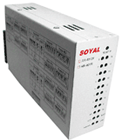
SOYAL AR-737H/U 125-485
SOYAL AR-721HV3-A silver
SOYAL AR-327EB
SOYAL AR-363ES Champagne
SOYAL AR-723HD-W Mifare silver
SOYAL AR-721HV3-A Mifare silver
SOYAL AR-829E-B Mifare gray
Access controls / Code keypads /Back New page  × | ||||||||||||||||||||||||||||||||||||||||||||||||||
Copyright © 2026 SOYAL™ | soyal.eu © | DELTON | All rights reserved.
|
||||||||||||||||||||||||||||||||||||||||||||||||||
| Our website uses cookies to make it easier to use, to which you contribute by further browsing. Information | × |
 EUR
EUR